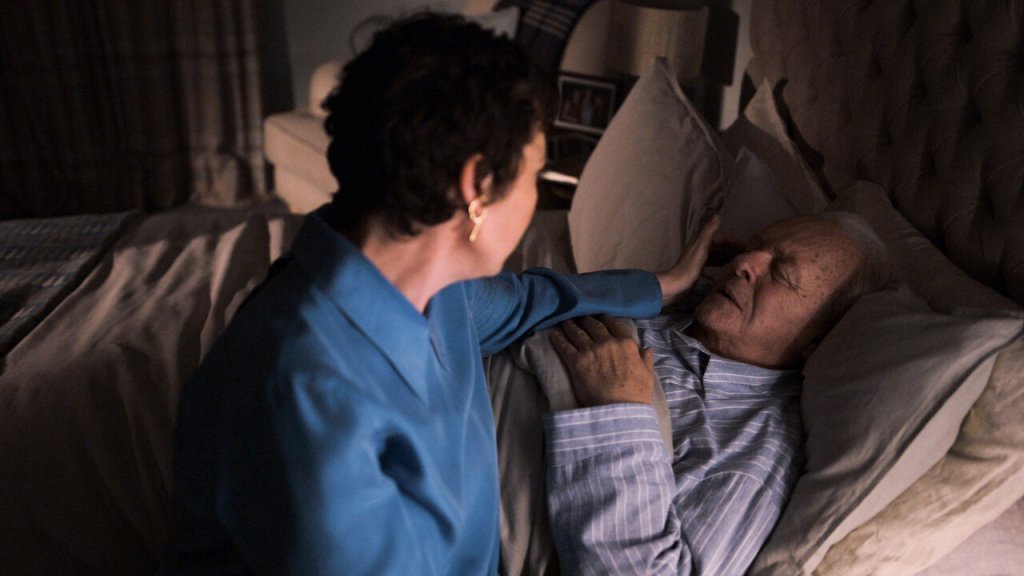
A few introductory words — what you are about to read is an incredibly long text that I wrote as an university assignment. Anthony Hopkins delivers a wonderful performance in this film, and if you are planning to watch it, prepare yourself to shed some tears.
The Father is a film that builds its narrative around the fundamental characteristics of human existence when confronted with the awareness of its inevitable end and the onset of the neurological disease of dementia. The story follows the progression of the illness and the accompanying anxiety experienced by Anthony, an elderly man whose care is entrusted to his daughter, Anne.
Old age, physical frailty, and illness, as embodied by Anthony, serve as the foundation for the exploration of multiple layers of human emotions, fears, and responses, while also providing a profound examination of the agony and insignificance that can overwhelm the human mind in the final stages of life. By exposing the human soul through the construction of subjective realities and the constant struggle with fears generated by the disease, the film portrays the fragility of human nature, as well as its desires and anxieties, in a manner that is both authentic and deeply affecting. As a result, it evokes feelings of pity, empathy, and compassion in its audience.
Equally compelling is the portrayal of his daughter, Anne, through whom the audience can clearly perceive how painful the gradual loss of a loved one can be, marked by helplessness and emotional powerlessness. The film depicts the complete breakdown of any stable connection with reality, a life overshadowed by the fear of constant manipulation by one’s family, and an unwavering belief in the accuracy of one’s own judgment concerning time, memory, and space.
The universality of the message that Florian Zeller conveys through this work—which earned Anthony Hopkins the Academy Award for Best Actor in 2021—lies precisely in its metaphorical richness and universal applicability. The film suggests that a person’s identity is essentially the sum of their defining memories and the ways in which those memories are reshaped through personal perception and the passage of time. Another significant underlying theme emerges in the father’s fear of losing his final connection to reality: his daughters, who represent the last meaningful concern of his existence. In this sense, the illness can be interpreted as a natural stage of life and an inevitable consequence of the human journey.
The brilliance of the film also stems from the way its narrative is constructed. Zeller weaves an intriguing story that initially astonishes viewers with its apparent lack of logical coherence, only to reveal, in its conclusion, the profound layers of the tragedy. Throughout the film, he maintains an exceptional sensitivity to detail and symbolism, ensuring that every frame contributes meaningfully to the emotional and thematic depth of the work.
From the very first seconds of the film, its central theme is foreshadowed through the careful selection of the opening musical piece. The aria “What Power Art Thou?” from Act III of the semi-opera King Arthur, or The British Worthy evokes the image of the Spirit of Winter, lying frozen beneath the snow, lifeless and unwilling to awaken, refusing all action except surrendering to the eternal sleep of death. The piece functions as a metaphor for Anthony’s consciousness. The disintegration of the self becomes an endless slumber—an act of sinking into oblivion, reflecting a profound unwillingness to continue life’s journey in its entirety. Anthony’s identity is undergoing an irreversible process of dissolution.
As the narrative unfolds, the audience begins to recognize behavioral patterns that establish the central conflict of the story. Anthony grows increasingly suspicious of the loyalty and devotion of those closest to him after learning that Anne, his only remaining daughter and caregiver, intends to leave. The role through which Anthony is most clearly defined is that of a father, and it is within this role that his fears acquire their deepest meaning. According to the traditional patriarchal perception of fatherhood, daughters are regarded not only as vulnerable individuals whom a father instinctively feels compelled to protect, but also as feminine reflections of their mother, with whom he forms an exceptionally strong emotional bond.
The film reveals that Anthony once had two daughters, the elder of whom died unexpectedly in an accident. The emotional devastation caused by the loss of one’s own child—someone sharing the same blood and lineage—is immeasurable. For a father, the death of a daughter, whom he may subconsciously feel an even stronger instinct to protect than a son, represents an especially profound psychological trauma. A parallel can be drawn with Sigmund Freud, who suffered the unexpected loss of his beloved daughter Sophie during the Spanish influenza pandemic. Freud later wrote that he remained inconsolable for years after her death, describing grief as something that never truly disappears. Likewise, Anthony’s mourning becomes permanent.
His grief may be understood as a psychological trauma giving rise to what psychoanalytic theory describes as motivated forgetting—a defensive process through which painful experiences become inaccessible to conscious memory. Although the concept of defense mechanisms was extensively developed by Anna Freud, it is important to note that motivated forgetting is more broadly associated with psychoanalytic thought rather than being exclusively defined by her. Within this interpretive framework, Anthony’s gradual withdrawal from reality can be viewed as a consequence not only of dementia but also of unresolved emotional suffering. His deteriorating mental state reflects an unconscious desire to retreat from an unbearable reality, allowing his consciousness to descend into oblivion.
Based on these observations, it may be concluded that the fundamental conflict presented in the film extends beyond the medical condition of dementia itself. At its core lies a father’s inability to come to terms with a loss that renders the purpose of his lifelong care and devotion seemingly meaningless. Anthony’s struggle is ultimately the struggle to preserve what has always constituted the greatest value in his life—his children, their well-being, and the love that binds a family together—even as both his memories and his identity gradually slip away.
Following Anne’s decision to leave in order to pursue a life that offers her greater fulfillment, the first unmistakable signs of Anthony’s psychological disintegration begin to emerge. He finds himself in an intense state of emotional distress, where the overwhelming fear of being abandoned by those he loves surpasses what remains of his already impaired judgment and moral stability. As a consequence, Anthony refuses to acknowledge the reality unfolding around him. Although he is, in fact, living in a nursing home, he continues to believe in his own constructed version of reality. He gradually becomes confrontational, persistently rejecting the accounts of those around him and, perceiving himself as under attack, responds with arrogance and hostility as a form of self-preservation.
Anthony’s relentless egocentrism is directed primarily toward his daughter Anne, who devotes herself entirely to his care and patiently accommodates his every demand. He readily makes hurtful accusations and constructs increasingly elaborate theories to reinforce his own perception of reality, grasping at unstable and contradictory evidence in an unconscious attempt to convince himself that he is not losing his mind. At the same time, Anne embodies a separate but equally significant conflict that intensifies the tragedy of Anthony’s condition. She represents the profound emotional burden and impossible moral choices faced by those whose loved ones are gradually consumed by illness and the passage of time.
When the two central characters are examined together, Anne and Anthony emerge as complementary opposites within the film’s ideological framework. Having endured first the death of her sister and then the gradual disappearance of the father she once knew and loved, Anne ultimately finds the strength to embrace a new beginning. She accepts that grief cannot be erased but must instead become a part of life. Anthony, however, is incapable of reaching such acceptance. Advanced age, compounded by irreversible cognitive decline, leaves him with nothing but bitterness, despair, and an inexorable process of psychological self-destruction.
The film’s visual and auditory symbolism subtly accompanies and enriches the narrative. The interior colour palette gradually shifts from warm yellows to increasingly cold shades of blue, while the arrangement and appearance of objects within the apartment change continuously. This careful manipulation of the mise-en-scène is one of the details to which Florian Zeller pays particular attention. The constantly transforming environment signals from the very beginning that the story unfolds not within objective physical reality but within Anthony’s subjective perception. The film’s setting ultimately becomes a composite space, blending Anthony’s memories of his own apartment, Anne’s apartment, and the nursing home into a single fragmented psychological landscape.
Anthony’s original living space is illuminated by soft lighting and warm yellow tones. Although yellow is often associated with warmth, optimism, and familiarity, it can also symbolize fragility, illusion, and psychological instability. As the narrative progresses, these colours gradually give way to colder blues, while the lighting becomes harsher and more clinical. This visual transformation mirrors the freezing of Anthony’s consciousness, his emotional isolation, and his gradual descent into oblivion.
Music likewise plays a crucial symbolic role throughout the film. Bellini’s aria “Casta Diva” from the opera Norma forms a narrative frame by appearing near both the beginning and the conclusion of the story. The aria expresses a plea for divine guidance and intervention, functioning as a metaphorical appeal for a deus ex machina—a force beyond human control capable of reversing Anthony’s decline. Yet no such intervention arrives, and his cognitive deterioration continues unchecked.
Another operatic work, “Je crois entendre encore” (“I Still Hear”), from The Pearl Fishers (Les pêcheurs de perles) by Georges Bizet, reinforces one of the film’s central themes: the bittersweet persistence of memory. The aria reflects a longing for a past that can no longer be fully recovered, capturing the painful distance between remembered happiness and present solitude. Within the context of The Father, it underscores the tragedy of a man whose memories—the very foundation of his identity—have become increasingly fragmented and ultimately unattainable.
The brilliance of The Father lies not only in its emotional depth but also in the intricate construction of its narrative and the meticulous attention to detail throughout the film. From the very beginning, the story subtly introduces what appears to be the catalyst for Anthony’s accelerating cognitive decline, although its significance only becomes fully apparent by the film’s conclusion. The one event that can be identified with relative certainty as belonging to objective reality is Anne’s decision to move to Paris. Everything that follows increasingly reflects Anthony’s progressive detachment from reality as his dementia advances.
One of the film’s most significant recurring motifs—and one of the clearest indications that Anthony is suffering from dementia, despite the diagnosis never being explicitly stated—is his wristwatch. He constantly misplaces it, creating a powerful metaphor for one of the hallmark symptoms of dementia: the progressive loss of temporal orientation. The watch symbolizes far more than a valuable possession; it represents Anthony’s fading ability to perceive and organize time itself. Notably, he tends to become concerned about the watch only in situations involving people whom he perceives as distancing Anne from him, such as the dismissed caregiver whom he accuses of stealing it or Anne’s husband. These figures represent obstacles to the exclusive care and attention he desperately seeks from his daughter. Consequently, the watch also symbolizes his fear of losing Anne’s affection and presence. Even as his cognitive faculties deteriorate, his emotional attachment to his daughter remains intact.
For first-time viewers, however, the logic underlying Anthony’s gradual estrangement from reality is intentionally difficult to perceive. Without knowledge of the complete narrative, audiences instinctively search for conventional causal relationships to explain the increasingly contradictory events unfolding on screen. This deliberate narrative ambiguity compels many viewers to revisit the film, where the carefully hidden chronological structure becomes considerably clearer.
One of the earliest indications that memories and reality have begun to merge occurs in the sequence where Anne appears with the face of another woman—who is eventually revealed to be a caregiver at the nursing home—and Paul likewise bears the appearance of another individual, later identified as a member of the nursing home’s staff. At this stage, Anthony’s internal world still maintains a partial correspondence with his external surroundings. Only after understanding the film in its entirety does it become evident that these scenes are presented entirely through Anthony’s perspective. He believes he is still living in his own apartment with Anne and Paul, while in reality he has already been admitted to a nursing home, and the woman he mistakes for his daughter is actually his caregiver. Chronologically, this sequence most likely takes place shortly after his institutionalization.
The following sequence initially appears to offer a reliable depiction of Anne’s life, presenting conversations and moments in which Anthony is absent. Since Anne remains mentally and emotionally stable, the viewer is led to believe that these scenes belong to objective reality. Yet this assumption ultimately proves false. The evidence lies in the appearance of Anthony’s new caregiver, whose face is identical to that of his deceased daughter, Lucy, even during scenes in which Anthony is not present. This visual continuity suggests that the audience never truly leaves Anthony’s subjective consciousness. The entire narrative remains filtered through his fragmented perception, where memories, fantasies, overheard conversations, and imagined events become inseparably intertwined.
Consequently, virtually every moment following the opening sequence should be understood not simply as a blend of memory and illusion but, at times, as complete psychological fabrication. Anthony’s mind constructs coherent explanations for experiences he can no longer understand, likely drawing upon fragments of conversations and sounds he overhears within the nursing home, where the proximity of other residents and staff makes such sensory impressions entirely plausible.
Within this framework, the scene in which Anne appears to suffocate Anthony should not be interpreted literally. Rather, it functions as the projection of his deepest fears and anxieties. It is a psychological narrative created by his own mind to explain his suffering, externalize responsibility, and transform those around him into persecutors while protecting himself from confronting his own helplessness and cognitive decline.
As Anthony’s condition worsens, his consciousness retreats progressively further into the past. His memories increasingly centre on Anne’s former husband, who becomes the earliest symbolic threat to Anthony’s exclusive relationship with his daughter. In Anthony’s perception, Anne’s husband embodies another source of emotional suffering, reinforcing the painful belief that he has become unwanted, burdensome, and ultimately destined to be abandoned. His mind continues moving backward through increasingly significant episodes of his life until it reaches its deepest psychological wound: the traumatic memory of the accident that claimed the life of his daughter Lucy. This final regression reveals that Anthony’s deteriorating mind is not merely losing memories but is instinctively returning to the origin of his greatest emotional trauma, suggesting that his fragmented identity remains anchored to the loss that irrevocably shaped the remainder of his life.
The reality in which Anthony exists is a form of escapism—a complete suppression of the true nature of his memories and his surroundings in order to construct an alternative world where the pain and agony of his decline are significantly diminished. However, the image of Lucy’s disfigured body lying in a hospital bed becomes the catalyst for the conflict between reality and illusion that exists within Anthony’s mind. His unbearable grief is what ultimately returns him to the nursing home room, becoming the voice that reminds him of his loneliness and the devastating nature of his condition.
Catherine, Anthony’s caregiver, reminds him that months have passed since Anne’s last visit, meaning that she must repeatedly reintroduce him to the reality in which he now exists. Anthony is no longer capable of creating new memories from the life he currently lives. His present consciousness and sense of self have deteriorated to such an extent that he regresses into the emotional state of a small child crying for his mother. This return to an earlier psychological state reveals a profound state of helplessness. At this moment, the viewer fully comprehends the essence of the film’s message: the story is ultimately about the decline of human life, accompanied by loneliness, longing for the past, painful reflections, and a broken spirit, all of which lead to the complete dissolution of identity.
What remains of Anthony is merely a physical body whose conscious existence has been irreversibly lost somewhere in the past. Particularly significant is the meaning conveyed by the final shot of Zeller’s masterpiece—a rare moment in which the film’s perspective turns outward toward the world beyond Anthony’s internal suffering. Whenever Anthony looks through the window of his room, he momentarily escapes the overwhelming agony of his existence. This brief moment of relief represents a small but profound pleasure of being alive, a moment in which pain and suffering temporarily cease to exist. The fundamental beauty of the external world becomes the key to genuine escapism.
This is precisely why Catherine repeatedly attempts to take Anthony outside for walks: her intention is to reconnect him with the simple pleasures of everyday existence during the final moments of his life. If the leaves of Anthony’s youth and rationality are gradually falling away, perhaps somewhere beyond the walls of his room—in the green trees, the movement of life, and the vitality of the outside world rather than within the confines of his memories—he might still discover a form of peace.
The universality of its message and the precision with which it is conveyed create an almost flawless formula for a successful film, and in this respect The Father stands as a remarkable example. Every human being retreats into private worlds at times and understands the fear of being perceived as irrational or incapable of independent thought. Even if one has never experienced such a loss of control, the fear of aging and its destructive influence has touched the thoughts of nearly everyone.
The film may be understood as an emotional catharsis for those who suffer, as it conveys a profound message: although suffering and grief remain burdens carried within the human soul, the appreciation of the simplicity and beauty of the present moment can offer a path toward acceptance and relief.
 KinoCritic
Leave a comment