
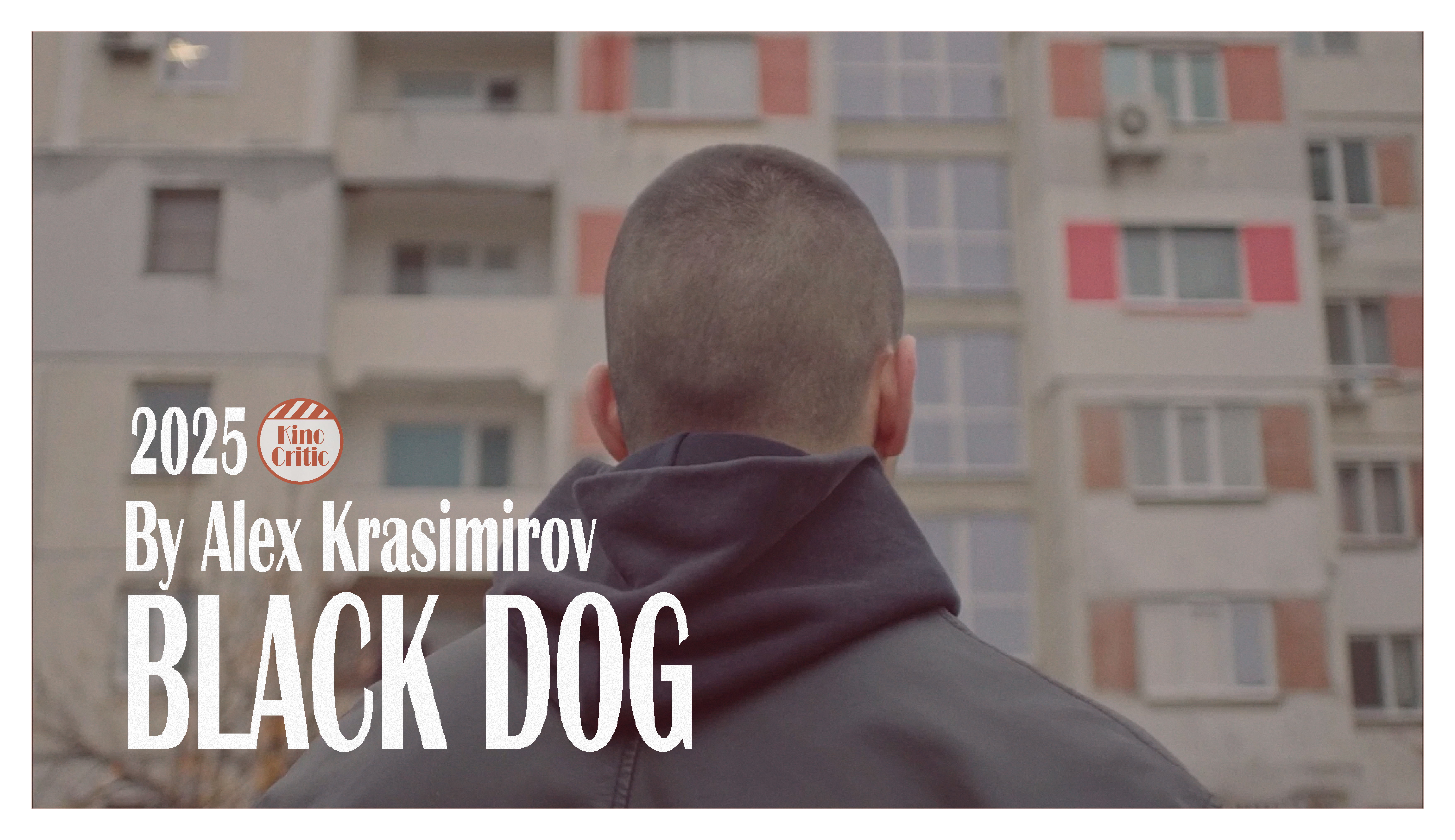
The first time I watched “Black Dog” I definitely didn’t like it. It felt like a segment of life that’s unfinished, as if there was probably something it was targeting to say, but it didn’t land. I had to do an interview with the author of this short, and thus I had to see it at least several more times. At some point I realized that I completely get it — the loneliness, the wandering, the weird feeling of not belonging at all. This review is translated from my original one on the platform KINEMATOGRAF.BG, where you can also stream it for free with English subtitles. I’ll leave a link. I’ll be glad to know what you think about it.

“After being released from prison, Ivan confronts the emptiness in his estranged family and his own fears. Wandering through the streets of Sofia, he tries to find a way to face his past and move forward.”

REVIEW
“Black Dog” is a short film that gives us the chance to step into the shoes of a familiar figure in our society – a troubled young man with a criminal record, a short haircut, and a deliberately menacing appearance. What’s more, it lets us sympathize with him in a way we might not under other circumstances. The film steers away from justifying the motives behind his actions and instead lets us follow a slice of the daily life of a lonely, misunderstood boy.
Ivan (played by Denislav Marinchev) is a young man, perhaps of high school age, who has just been released from prison. On the first day of his newfound freedom, he sets out on a journey through a post-socialist urban landscape in search of a place in the sun and someone to talk to, through whom he might feel understood. From pointless conversations with a psychologist to emotional estrangement from his family, the protagonist exhausts the few contacts that might soothe his need for connection.
We don’t learn much about the protagonist’s backstory, nor about the circumstances that led him down the wrong path. As for the world he lives in and his relationships with those around him, they are so close to a plausible reality that examining them with the same scrutiny one would apply to authorial hints in any other fiction would be pointless. Simply put, what we observe is a realism that succeeds wonderfully in conveying an authentic reality. Although the specific circumstances are fictional, “Black Dog” reflects and documents, in its own way, a very real emotional world in which many boys like Ivan live.
Bulgarian realism is a fading yet distinctive movement that in recent years has told more than one devastating domestic drama, and among all such overwhelming plots, “Black Dog” feels like a breath of fresh air. I believe the reason for this is the following – the short film avoids relying on hyperbolic extremes, shattered relationships, and extreme tragedy in order to make its plot appealing to viewers’ attention. Care and love are present in our protagonist’s world, and the tragedy lies not in their absence, but in their inability to fill the emptiness of his soul. In this sense, the filmmakers have approached the construction of a complex inner world and relationships that feel authentic with great care, which is commendable.
“Black Dog” is a film that captures within itself a fragment of a social phenomenon we observe among young people today. It introduces us to a character left to the mercy of fate, like a dog without an owner. It tells us about a kind of collective portrait of an entire subculture and allows us to look through its lens. It doesn’t excuse the vicious, nor does it wrong anyone, but it lets us come closer to the feeling of loneliness and misunderstanding experienced by boys like Ivan.