
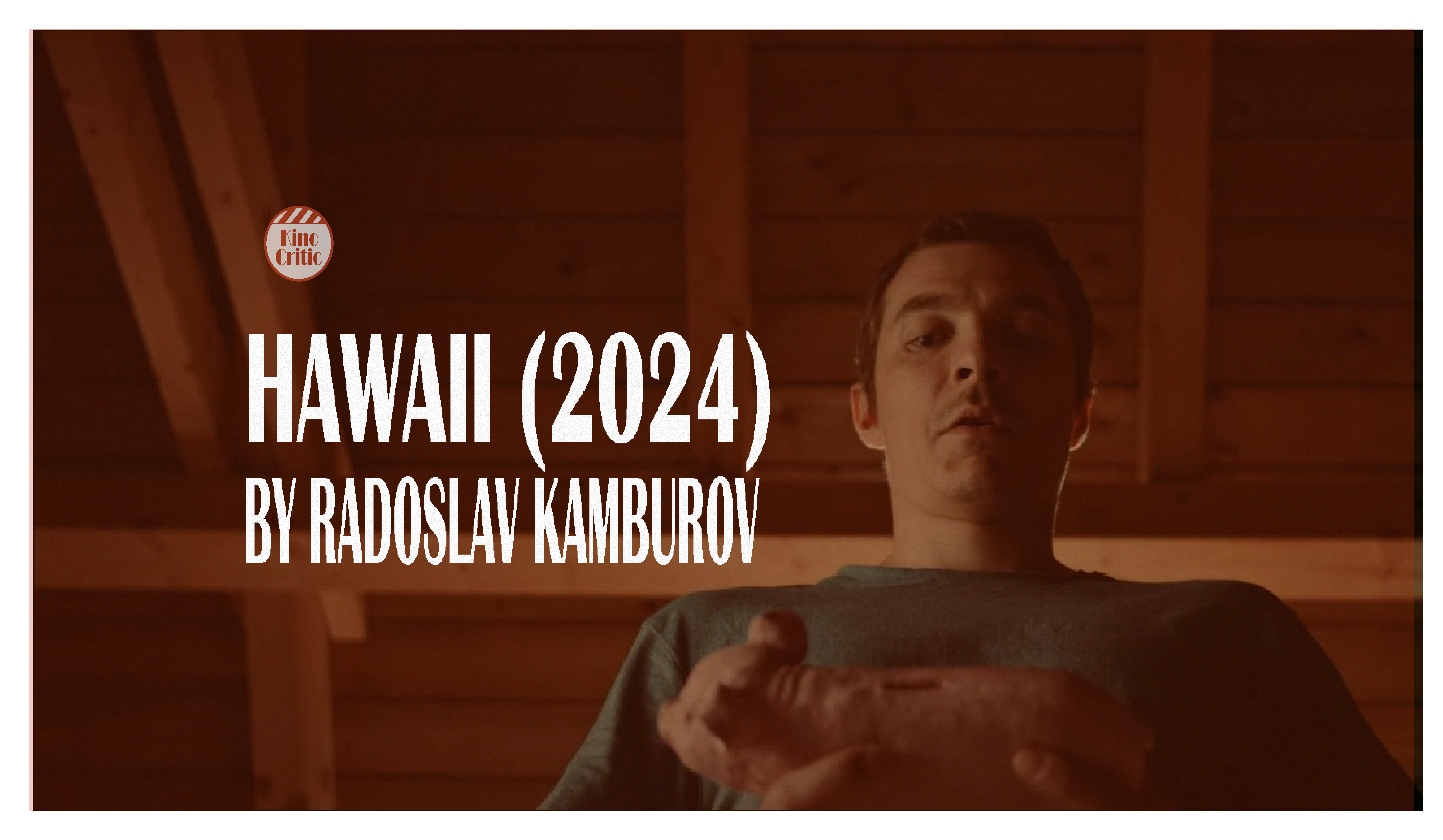
I first saw Hawaii at the Sofia International Film Festival last year (2025). It was screening alongside one of my own films—they were competing in the same category—and, quite honestly, after watching it for the first time, I found myself hoping it would win an award. I remember it with remarkable clarity even a year later. I’m not sure whether that’s because of its masterful visual storytelling, Yordan Rŭsin’s outstanding performance (without uttering a single word, incidentally), or simply the originality of its overall concept. In any case, if a story stays with you for that long, it has probably succeeded.
Imagine a young man living alone in filth and squalor, leading what, by conventional social standards, appears to be a purposeless existence. Sadly, that is not a difficult image to conjure today. This archetype feels particularly relevant in our digital age, which offers all the conditions for a sedentary and stagnant way of life. The man, Ivan, works an utterly meaningless job with no prospects for advancement: he is a click worker, spending his days at home watching online advertisements. Perhaps I was a little too harsh in calling his life meaningless, because Ivan himself has given it meaning. His one and only dream is to travel to Hawaii, and clicking on ads is the financial stepping stone toward that sublime moment. Everything in his already stagnant existence carries on quietly until the squalor of his home finally catches up with him. A stubborn rat infesting his apartment becomes an unexpectedly formidable obstacle standing between him and his dream.
To me, this short film is deeply philosophical. It subtly places the life of a modern human being on the same level as that of a rat, and in the context of contemporary economic reality, perhaps with good reason. That may also explain why it feels so relevant. Modern capitalism is notorious for feeding only the predators at the top of the food chain, while ordinary working people are often left with the scraps. There are countless examples of hardworking individuals who struggle just to put bread on the table, let alone afford the luxury of visiting a destination they have dreamed about for years. To me, that is a genuine tragedy. In a truly functioning society—not a utopian one—a person ought to have the freedom to travel, create, learn, or simply spend their leisure time however they choose. Yet reality is far removed from that ideal. Ivan, as a composite portrait of the ordinary working person, ultimately finds himself even lower in the food chain than the rat. His dream—hardly an extravagant one—proves attainable only over his dead body. That is an unsettling idea, and one worth reflecting on.
At the same time, the film is not entirely bleak. As desperately as Ivan wants to eliminate his greatest enemy—the rat—his repeated attempts to kill it reveal something essential about his character. Just before he finally succeeds, the audience realizes that he is, in fact, a compassionate and decent human being, incapable of taking a life without hesitation. Because of that moral instinct, the protagonist ultimately reaches the paradise he has always dreamed of, though not in the way he expected. This ambiguity is one of the film’s greatest strengths. It allows for two equally valid interpretations: reality is profoundly miserable, yet dreams can still come true, albeit through absurd and unexpected means. It is precisely this complexity that makes the story so compelling.
Hawaii is a masterfully crafted short film that, without a single line of dialogue, lays bare the absurdity of our modern existence. It asks how the contemporary world has stripped people of the wings they need to pursue their dreams, and why even life’s simplest pleasures have become so prohibitively expensive. Through Ivan’s absurd predicament, the film tells the story of a man who unknowingly gives up his life in pursuit of something that, in a fairer world, ought to be far more attainable, but has instead been wrapped in such dazzling allure that it has become virtually impossible.